Generative Engine Optimisation (GEO): How Australian DTC Brands Get Sourced by ChatGPT and Perplexity

The Death of the 10 Blue Links: How Answer Engines Synthesise Brand Recommendations
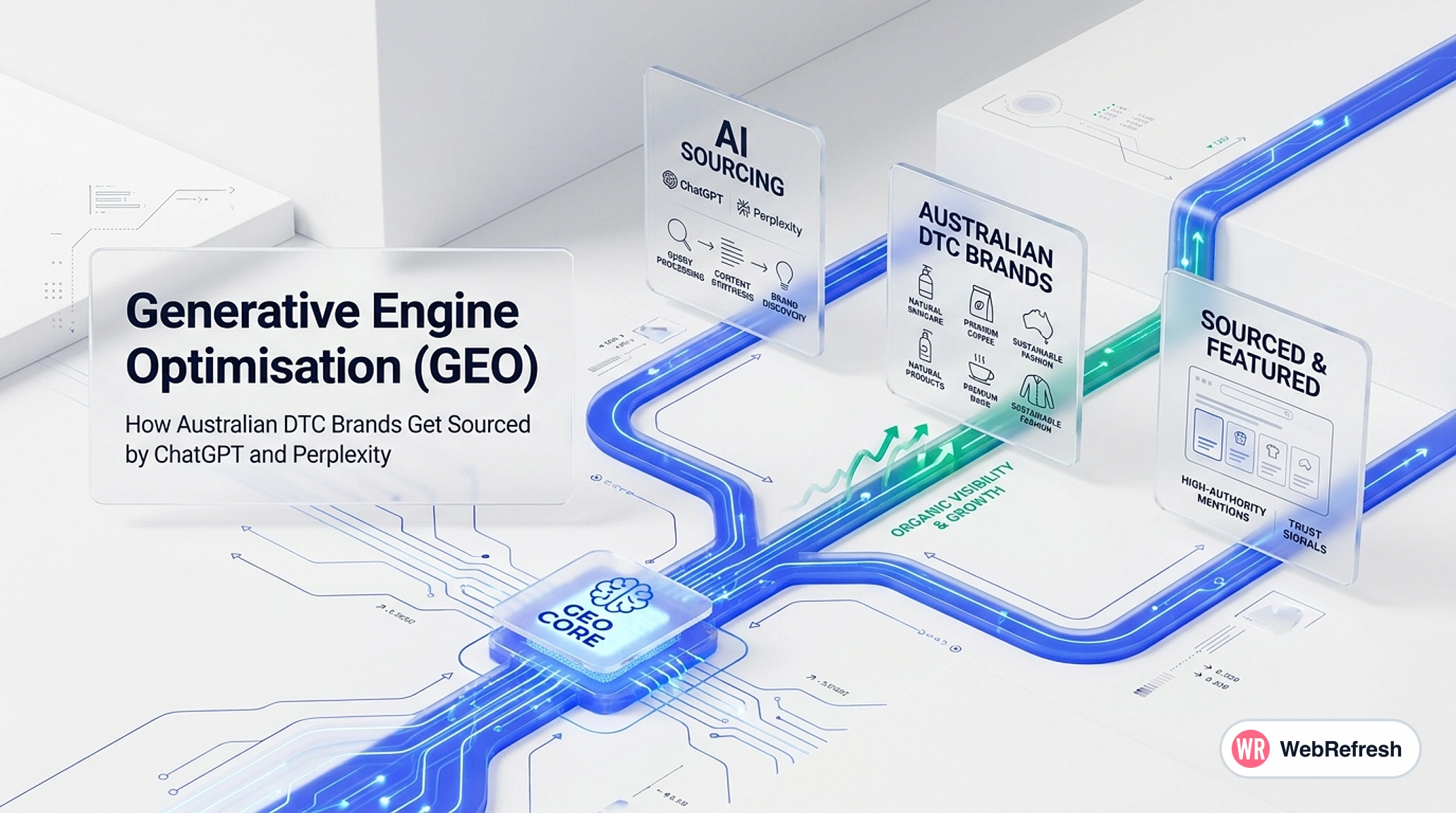
Generative Engine Optimisation (GEO) is the systematic process of structuring your digital footprint, on-page architecture, and technical schema so that Large Language Models (LLMs)—including ChatGPT Search, Perplexity AI, Claude, and Google AI Overviews—actively retrieve, synthesise, and cite your brand as the definitive recommendation for high-intent queries.
For more than a decade, eCommerce growth was governed by a familiar playbook: build out collection pages, target high-volume non-brand keywords, build domain authority, and secure a spot in the traditional top-three organic rankings. If you held positions one through three, you captured 50% or more of search demand. That deterministic model is rapidly breaking down across Australian retail.
Today, high-value shoppers are skipping search engine result pages (SERPs) entirely. Instead of searching for "best natural sleep supplement Australia" and clicking through five separate affiliate articles, buyers are asking conversational engines: "I'm a 38-year-old runner experiencing poor REM sleep; what Australian magnesium glycinate brands use clean fillers, third-party testing, and offer subscription discounts?"
When an answer engine processes that prompt, it does not display ten blue links. It constructs a bespoke, multi-source narrative. It cross-examines product data sheets, user reviews, digital PR coverage, and on-site technical markup in real time, serving a synthesised answer with embedded citation links. If your brand is not structured for LLM ingestion, you are completely invisible to this surging cohort of high-intent buyers.
Generative engines do not evaluate keywords in isolation; they evaluate semantic entities, consensus across the web, and structured facts. To win conversational commerce queries, direct extractability must replace traditional keyword stuffing.
The Direct Answer Architecture: Structuring Content for LLM Scraping and Attribution
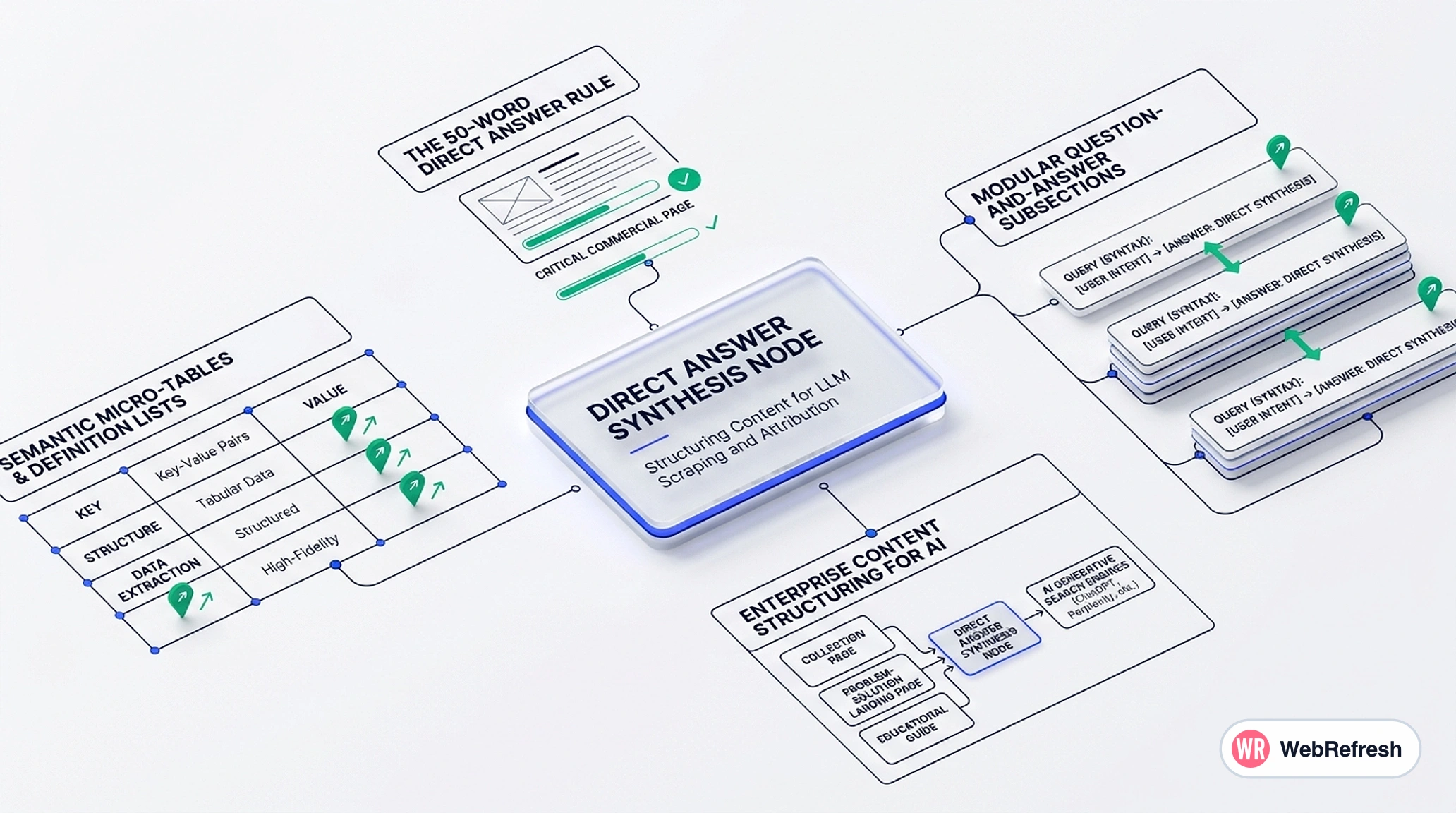
To win citations across ChatGPT Search and Perplexity, eCommerce brands must completely rethink page-level information architecture. Large language models operate under tight token budgets and strict context window limits. When AI crawlers (like GPTBot, PerplexityBot, or Google-Extended) scrape your product and collection pages, they prioritise structured, concise information blocks that can be parsed with minimal computation.
1. The 50-Word Direct Answer Rule
Every critical commercial page on your site—whether a collection page, a problem-solution landing page, or an educational guide—must feature a clear, direct answer in the first two sentences below its primary heading. If your page discusses "Fisetin dosage for cellular health", opening with three paragraphs of generic musings about wellness guarantees that an LLM summariser will bypass your content in favour of a more concise medical journal or competitor page.
2. Semantic Micro-Tables and Definition Lists
LLMs excel at extracting tabular data and structured key-value pairs. By converting long-form product claims into structured HTML tables, you provide answer engines with easily digestible tokens. Consider how these formats compare:
- Raw Narrative Format (Low GEO Extraction): "Our daily longevity formula contains 500mg of pure trans-resveratrol sourced from Japanese knotweed, combined with 250mg of bio-enhanced fisetin, manufactured inside a TGA-certified Australian facility."
- Structured GEO Format (High Extraction): A clear HTML definition list or table explicitly mapping Attribute to Value (e.g., Active Ingredient: Trans-Resveratrol | Dose: 500mg | Extraction Source: Japanese Knotweed | Compliance: TGA Registered).
3. Modular Question-and-Answer Subsections
Structure supporting copy using literal query syntax in your <h3> tags. Frame subheadings around exact conversational buyer queries, followed immediately by bolded, declarative answers before expanding on the underlying science or methodology.
On-Page Recommendation Signals: What Answer Engines Look for on PDPs and Collection Pages
When an AI engine synthesises a commercial recommendation, it acts as a risk-averse concierge. It wants to provide the user with an answer that will not backfire. To qualify for direct product recommendations, your Product Detail Pages (PDPs) and Collection Pages must present undeniable operational, trust, and quality signals in plain text and structured code.
1. Operational Certainty: Shipping, Returns, and Warranty Commitments
Prompt buyers regularly layer operational constraints onto their searches (e.g. "sustainable work boots under $300 with free Australian returns and a minimum 12-month warranty"). If these operational details are hidden behind dynamic popups or unindexed checkout flows, answer engines will simply omit your brand.
- Explicit Delivery SLAs: Clearly state metro vs. regional dispatch times (e.g., "Dispatched within 24 hours from Sydney warehouse; 2–4 business days delivery via Australia Post").
- Unambiguous Returns Windows: Outline the exact return window in bold text on the PDP (e.g., "30-day risk-free returns, prepaid return labels provided").
- Warranty Terms: Document structural, mechanical, or satisfaction warranties directly in the product specifications block.
2. Radical Sourcing and Ingredient Provenance
Generative engines favour objective facts over subjective brand marketing. Instead of stating that your skincare or supplement line is "pure and natural", provide exact, verifiable credentials:
- Raw Material Provenance: Detail the geographical source of every active ingredient or fabric (e.g., "100% GOTS-certified organic cotton milled in Melbourne").
- Certifications and Regulatory Listings: Display formal registration numbers, TGA listings (AUST L numbers), ACO Organic seals, or B-Corp certification IDs directly on the page.
- Material Purity Metrics: Publish explicit purity percentages, concentration ratios, and carrier oil compositions in structured definition lists.
3. Verifiable Trust Elements: Reviews, Awards, and Batch Audits
To guard against synthetic hallucination, LLMs perform automated consensus validation. They look for explicit trust anchors that corroborate your claims:
- Machine-Readable Customer Reviews: Surface genuine customer reviews rendered directly in static HTML (not trapped behind client-side JavaScript tabs) enriched with complete
AggregateRatingschema. Include structured review attributes such as verified buyer badges, usage duration, and skin/body type context. - Independent Batch Audits & COAs: Provide direct access to batch testing summaries or downloadable Certificates of Analysis (COAs) confirming heavy metal screening and active potency. LLMs interpret independent laboratory verification as an authoritative proof point.
- Accredited Industry Awards: State the exact issuing body, award category, and year won (e.g., "Winner: Best Australian Clean Skincare Formula — 2024 Clean + Conscious Awards") alongside links to the awarding entity.
4. Dedicated Care, Sizing, and Post-Purchase Guides
Consumers frequently consult conversational search for post-purchase advice (e.g., "how to condition pull-up leather boots" or "can I take berberine with morning coffee"). Hosting authoritative care, dosage, and maintenance guides directly on the relevant product pages turns your PDP into an all-in-one semantic hub that answer engines cite for both pre-sale and post-sale queries.
5. Collection Page Facet Explanations and Decision Trees
Traditional collection pages often present a silent grid of product cards. For high GEO performance, collection pages should feature contextual decision blocks above or below the product grid: explaining who should choose Product A versus Product B, comparing formulations, and providing structured mini-FAQs that directly answer common category-level hesitations.
How AI Evaluates Brands: The Generative Assessment Matrix
To visualise how an LLM scrutinises eCommerce websites during prompt evaluation, examine how an AI engine evaluates three hypothetical Australian supplement brands when responding to a high-intent commercial prompt:
| Evaluation Vector | Brand A: PureNootropics AU Full GEO Optimised |
Brand B: ApexVitality Legacy SEO Only |
Brand C: ZenGlow DTC Unstructured Marketing |
|---|---|---|---|
| Technical Schema Markup | Deeply nested JSON-LD (Product, Brand with Wikidata sameAs, MerchantReturnPolicy, ShippingDetails). | Generic automated Shopify schema; missing return policy and shipping time entities. | No structured schema; product details rendered dynamically via client-side JavaScript. |
| Operational Transparency | Plain text SLAs: "Dispatched in 24h from Sydney, 30-day free Australian returns". | Vague shipping mentions ("Fast dispatch"); returns policy buried on a separate unlinked page. | No explicit dispatch times; checkout modal required to view shipping costs. |
| Trust & Audit Verification | Public batch lab audit COAs, TGA listing (AUST L 392810), 4.9/5 verified reviews with schema. | Claims "TGA Compliant" without listing number; reviews rendered inside an unindexed JS widget. | Subjective marketing claims ("100% pure"); unverified static quote blocks without ratings. |
| Content Extractability | 50-word direct answers, structured ingredient dosage tables, modular FAQ sections. | 1,500 words of keyword-stuffed narrative prose with zero tabular comparisons. | Minimal text; primarily image banners and video modules without descriptive alt text. |
| AI Citation Outcome | Primary Citation: Synthesised as the top recommended brand across Perplexity and ChatGPT. | Secondary Mention: Occasionally referenced in extended research but skipped for direct answers. | Omitted: Excluded from recommendation sets due to unverified claims and poor crawl extractability. |
Entity Grounding: Using Annotated Schema and Digital PR to Secure AI Citations
Large Language Models are prone to hallucination. To prevent generating false information, AI search engines rely on a validation process known as Entity Grounding. They verify facts across a web of interconnected semantic entities before citing a brand as an authoritative answer.
Advanced JSON-LD Structured Data
Standard out-of-the-box Shopify or WooCommerce structured data is no longer sufficient. Winning generative citations requires deeply nested, disambiguated schema markup that explicitly defines entity relationships.
{
  "@context": "https://schema.org",
  "@type": "Product",
  "name": "Bio-Enhanced NMN Longevity Complex",
  "image": "https://example.com.au/images/nmn-complex.jpg",
  "description": "Pure pharmaceutical-grade Nicotinamide Mononucleotide stabilised for high bioavailability, verified by independent Australian third-party lab testing.",
  "brand": {
    "@type": "Brand",
    "name": "Longevity Australia",
    "sameAs": [
      "https://www.wikidata.org/wiki/Q_YOUR_ENTITY",
      "https://www.crunchbase.com/organization/longevity-australia"
    ]
  },
  "hasCertification": {
    "@type": "Certification",
    "name": "TGA Certified GMP Production"
  },
  "aggregateRating": {
    "@type": "AggregateRating",
    "ratingValue": "4.9",
    "reviewCount": "148"
  },
  "offers": {
    "@type": "Offer",
    "priceCurrency": "AUD",
    "price": "89.00",
    "availability": "https://schema.org/InStock",
    "hasMerchantReturnPolicy": {
      "@type": "MerchantReturnPolicy",
      "applicableCountry": "AU",
      "returnPolicyCategory": "https://schema.org/MerchantReturnFiniteReturnWindow",
      "merchantReturnDays": 30,
      "returnMethod": "https://schema.org/ReturnByMail",
      "returnFees": "https://schema.org/FreeReturn"
    },
    "shippingDetails": {
      "@type": "OfferShippingDetails",
      "shippingRate": {
        "@type": "MonetaryAmount",
        "value": "0.00",
        "currency": "AUD"
      },
      "deliveryTime": {
        "@type": "ShippingDeliveryTime",
        "transitTime": {
          "@type": "QuantitativeValue",
          "minValue": 1,
          "maxValue": 3,
          "unitCode": "DAY"
        }
      }
    }
  }
}
By connecting your brand node to authoritative entities via sameAs arrays and explicitly detailing return and shipping policies in schema, you supply the knowledge graph with verifiable anchor points that AI citation algorithms rely on when cross-checking claims.
Corroboration Through Tier-One Digital PR
Perplexity and ChatGPT do not evaluate your website in a vacuum. When an AI search engine evaluates whether to recommend your product, it queries its index for third-party consensus. If your brand claim is not corroborated by external, high-trust publications, the AI categorises your site as unverified marketing copy.
In our client campaigns at WebRefresh, we build structured digital PR roadmaps that place product mentions, founder commentary, and technical reviews across authoritative Australian media, industry journals, and vetted third-party portals. When an LLM processes queries, this web of third-party validation provides the necessary confidence threshold to trigger direct citations.
Case Framework: How a High-Growth DTC Supplement Brand Reclaimed Top-of-Funnel AI Visibility
To understand how this functions in the field, consider an engagement from our agency archives involving a fast-growing Australian DTC health and longevity brand. Despite strong brand equity and robust top-line performance, the brand experienced a 43% decline in traditional search clicks following widespread rollouts of AI Overviews and conversational answer bots.
The Diagnosis
Our deep technical and entity audit identified several critical bottlenecks holding back their generative search footprint:
- Fragmented Schema Implementations: The site contained broken JSON-LD syntax across product detail pages (PDPs) and conflicting canonical tags on paginated customer review loops, preventing LLM bots from extracting verified customer sentiment.
- Disconnected Entity Graphs: Product ingredients (such as Alpha Lipoic Acid, NMN, and Fisetin) were discussed in conversational blog posts without explicit semantic connections to the actual commercial product entities.
- Lack of Third-Party Corroboration: While on-site educational copy was comprehensive, there was little external digital PR validation across high-authority Australian publications linking those specific health mechanisms back to the brand.
The Remediation Strategy
Over a focused 90-day implementation cycle, we deployed a rigorous three-pronged GEO framework:
- Technical Canonical & Pagination Refactoring: We resolved PDP review pagination canonical bugs, eliminating duplicate indexation bloat and allowing search crawlers to seamlessly parse verified user reviews.
- Annotated JSON-LD Entity Markup: We deployed deeply annotated schema across all core collections and articles, connecting product formulations directly to verified biomedical entities in Wikidata.
- Targeted Digital PR & Product Brief Distribution: We executed an authoritative outreach campaign securing contextual mentions in high-authority Australian health and business publications, establishing independent consensus.
Within 8 weeks of schema re-annotation and digital PR indexation, the client's products achieved primary citation placements in ChatGPT Search and Perplexity for over 40 high-intent transactional queries, reversing top-of-funnel declines and driving a surge in qualified, high-converting referral sessions.
Step-by-Step Implementation: The 5-Point GEO Checklist for Australian Brands
If you are managing an Australian DTC or B2B eCommerce brand, you can take practical steps today to position your site for generative engines. Here is our recommended deployment checklist:
1. Audit and Whitelist AI Crawlers in robots.txt
Many brands unknowingly block the very bots responsible for generating AI answers. Check your server configurations and robots.txt file to ensure you are not blocking GPTBot, OAI-SearchBot, PerplexityBot, or Google-Extended, unless you have explicit commercial reasons to do so. Ensure your CDN does not trigger aggressive Cloudflare JS challenges against verified AI indexing user agents.
2. Re-Architect Key Pages with Direct Answer Blocks and Operational Specs
Review your top 20 revenue-generating collection and product pages. Add a dedicated, highly structured "Direct Answer & Specifications" module directly above the fold. Ensure shipping windows, warranty details, returns policies, and sourcing certifications are stated in clear, extractable text.
3. Implement Deeply Nested Product & Organisation Schema
Upgrade from basic automated eCommerce schema to custom, hand-crafted JSON-LD. Ensure your Organization and Product markup includes complete details: sameAs profiles, accurate price specifications, currency codes, batch test certifications, return policies, and explicit about and mentions entity references.
4. Deploy Digital PR Focused on Third-Party Consensus
Stop buying low-quality directory links and syndicated press releases. Instead, pitch compelling founder insights, unique Australian market data, and proprietary product testing to legitimate journalists and vertical-specific media. The primary goal of modern off-page SEO is providing unshakeable validation for AI citation engines.
5. Monitor Conversational Prompts via GA4 and specialised Trackers
Set up custom regex filters in Google Analytics 4 to track inbound referral traffic from generative domains (e.g., android-app://com.perplexity.search, chatgpt.com, claude.ai). Regularly run test prompt sweeps across your brand's core commercial keywords to monitor how your brand is being summarised, which competitors are cited alongside you, and what sentiment is conveyed.
Future-Proofing Your Organic Discovery
Search is no longer a static list of ten blue hyperlinks. It is an interactive, conversational synthesis layer that evaluates your brand's authority, clarity, and external validation in real time. Winning in this environment does not require abandoning SEO fundamentals; it requires elevating them with technical precision, entity grounding, and uncompromising operational transparency.
The brands that adapt to Generative Engine Optimisation today will dominate AI recommendations for years to come. Those that cling to outdated tactics risk vanishing from consumer consideration entirely.
Ready to position your eCommerce brand at the forefront of AI search? Book a comprehensive search audit with WebRefresh today. Over the past 12+ years, we've helped Australian DTC and B2B leaders dominate search landscapes through data-driven technical execution, advanced entity schema, and proven growth strategies.